Category Archives: Blog

What Makes Fictional Settings Feel So Real? Examples from Popular Fiction

I love books where the setting is central to the plot.

In fact, I would say that in these cases, the setting itself is a character in the story.

In this post I’d like to share with you three things that make these setting so memorable. (And, if you are a writer, how you can write settings that will really have an impact on your readers.) I’m also going to share some examples from Popular stories to give you an idea of what this looks like in action.

A setting plays a deeper role in a story when it:

  1. Uses all the senses. When we walk around the world we aren’t just seeing the places we go, we are experiencing them will all of our senses. Instead of just describing the way a setting looks, be sure to add the way it feels, sounds, and smells to help your reader feel immersed in the setting as they read.
  2. The characteristics of the setting allow it to affect the plot and the other characters in the story. If a character is dealing with feelings of seclusion, loneliness, or self-reliance, then setting your story on an island or a cabin up in the mountains would be a great way to reflect these inner struggles. Having a setting that reflects the inner world of your characters or that physically affects their choices or conflicts can really make the setting stand out.
  3. The little details matter. Every story has a setting, but the little details about the settings are what make it real. It’s one thing to say a character is standing in a garden. It’s another to say that they are standing in an overgrown garden with a chipped white fence where the gate creeks loudly and the weeds snag at their skirt as they walk down the rocky path to the dirt road. The details give the setting its personality.

Below I’ve provided some vivid examples from literature where the setting has a lot to do with the overall story and the charter’s experiences.

  • Love in a Fallen City by Eileen Chang – The first novella in this collection starts with beautiful descriptions of the house and garden, but it intentionally reflects the blend between Eastern and Western aesthetics. This sets the deeper themes of the story by reflecting the characters’ struggles in navigating a social class system that blends Chinese and English cultural expressions.
  • Neverwhere by Neil Gaiman – The setting in this story is really the central focus, while the characters are merely moving through this world at the mercy of what the setting has in store for them. Neverwhere is unique in that the setting is both fantastical and modern at the same time. The story takes place in London, but not just the way we experience it today, and instead in a parallel universe of sorts where fantasy becomes reality. Gaiman’s more popular story, Coraline, uses those sensory descriptions I mentioned earlier, and even though the book is short, the setting really makes the story extra creepy.
  • The Writer’s Retreat by Julia Bartz – This story, like many other thrillers, utilizes a house in a secluded area as the backdrop of the terrifying drama that unfolds. Similar stories include The Hunting Party by Lucy Foley, and We Used to Live Here by Marcus Kliewer. These stories, and the circumstances faced by their characters, would not be possible if they were set anywhere else. That’s the power of a well-chosen setting.
  • Harry Potter by J.K. Rowling – The magical world and Hogwarts Castle are half of what makes this series so captivating. Just take a look Universal’s “Harry Potter Land” in Orlando. It really is the setting of a hidden magical world within our modern world (much like Neverwhere) that makes these stories feel so real for us. And more than that, this setting was well-crafted down to the details awhile also containing expansive world building.

Settings really do have the power to take us to a whole new world, and to feel the emotional depth of a story as we walk side-by-side with the characters, wherever they go.

*Author’s Note: In my blog I might reference stories or authors that are considered controversial. However, throughout my studies I have taken the stance that removing the artist from their art is sometimes necessary in order to see the beauty of the fantasy behind the grim reality. After all, that’s what stories are for. They give us hope when the world lets us down. Unfortunately, sometimes that person that lets us down was the one holding the pen.

How to Publish a Book on Amazon KDP

So, you’re ready to publish your first book?

First of all, congratulations! Writing a book is the hardest part. In fact, the percentage of authors who actually complete their first manuscript is estimated to be as low as 3%.

But books are made to be read, so if you’re ready to publish your manuscript, keep on reading. Below is a step-by-step guide to publishing your book TODAY!

What is Amazon KDP?

KDP stands for Kindle Direct Publishing. It is a self-publishing platform that is owned by Amazon, which helps your book to reach the audiences that order books and ebooks through Amazon and Kindle.

There is no need for paying for printing because KDP is print-on-demand, so the cost is immediately covered by their share, and you receive the money left over after production.

The percentage of royalties made by the author (you) depends on the format your book is in:

If you publish a paperback, you will receive 60% of the list price leftover after printing cost. That is WAY more than the average royalty for traditionally published paperbacks which usually hovers around 10-15%.

If you publish an ebook, KDP gives you two different distribution options which come with different royalty percentages. The first one is called KDP Select, and it comes with a whopping 70% author royalty. For a book to qualify for Kindle Unlimited it needs to be sold exclusively on Amazon and needs to be prices between $2.99 and $9.99. KDP Select also comes with perks like enrolling your book into Kindle Unlimited and having access to different types of book promotions. All other ebooks will receive a 35% author royalty, which is still considered a great cut for authors.

How to Publish Your Book on KDP

Before you start publishing, make sure you format your book. This should include mirrored margins with a .5 on three sides and a .75 on the internal side. Choose the right font and type size for your book to be easy to read and make sure you have any copyright pages, a table of contents, and any other book format requirements your book needs to be complete.

Once you are ready to publish go to KDP and create an account. When you get to your dashboard you will see options to create your book in either paperback, ebook, or audiobook. (This is a new feature they are still perfecting, and it can only be done with current ebooks for now.)

Here is a list of all of the things you need have ready to input when you publish your book:

  • Title and subtitle or series name
  • Names of authors, illustrators, editors, or others that worked on the book
  • Description of your book (this should be at least 1-2 paragraphs)
  • ISBN (This is basically the product number. You can buy your own at Bowker or you can let Amazon assign one to you. Note: If you use Amazon, this will automatically identify your book as being self-published to sellers.)
  • Book cover. I recommend Self Pub Book Covers if you don’t want to make your own. If you are creative, Canva has great options for designing book covers.
  • Book genre and key words
  • Book blurb for the back of the book
  • Price you want your book to be listed for
  • Manuscript of you book (you should have both a Word document or Google doc and a PDF)

Hopefully, this guide can help you get started publishing today.

Subscribe for more writing tips and book reviews!

Finding Your Voice as a Romance Writer

If you had asked me a decade ago if I would be a romance writer, I would have said, “Hell no! That’s cheesy stuff. I want to be a serious writer.”

And yet, here I am. Not only am I a romance writer, but I’m proud to be one. The truth is that romance writing is just as powerful and important as other forms of writing. Romance stories have healed my life, and I hope my stories help others find healing, too.

But like many readers and writers, I fell for the misconceptions about the genre, believing it was just a bunch of nonsense written to entertain the masses with no depth or development. Now, some specific niches in the romance genre might be made simply for entertainment, and that’s perfectly fine, too.

But that’s just it: there are different niches for different people. And that’s great! But how do you find YOUR niche?

Finding your niche might feel a bit crazy because your writing style might differ from your reading style. Or, even crazier, it might be completely different from your lifestyle. (Quick examples include Dr. Seuss never having children and the great romance writer Jane Austen never marrying. And don’t get me started on Stephen King…)

So, to help you on your journey, here are 3 steps you can take today to start you on your romance writing path:

  1. What are your fantasies? Yikes, sorry to get so personal right off the bat here. But your personal, romantic fantasies can help guide your writing. Writing fiction is a lot of daydreaming and writing down your thoughts, so it can be easiest to start with things you already fantasize about. This can be as simple as fantasizing about a relationship built on mutual experiences, something cute like a Hallmark Christmas movie. And it can be as wild as whatever your deep, dark, secret “kinks” are. Whatever you like to think about, try writing it down.
  2. What do you like to read? Writers are also avid readers. So, when it comes to romance (even if it was just a subplot), what types of relationships do you usually enjoy reading about? Are they enemies to lovers? Love triangles? Maybe you like paranormal romance and want to get down on some werewolf action. Whatever niche you enjoy as a reader could also help guide you as a writer.
  3. Ask yourself what is missing from the romance market. My sister always told me if I didn’t find the kind of painting I wanted at the store, I should just paint it myself. This is true of writing, too. If there is a type of romance story you have always wanted to read but have struggled to find it anywhere, that’s a great place to start for writing a book! Chances are, someone else is looking for it, too.

Hopefully, these helped you out. Don’t forget to subscribe to my blog for more writing tips!

Happy writing 🙂

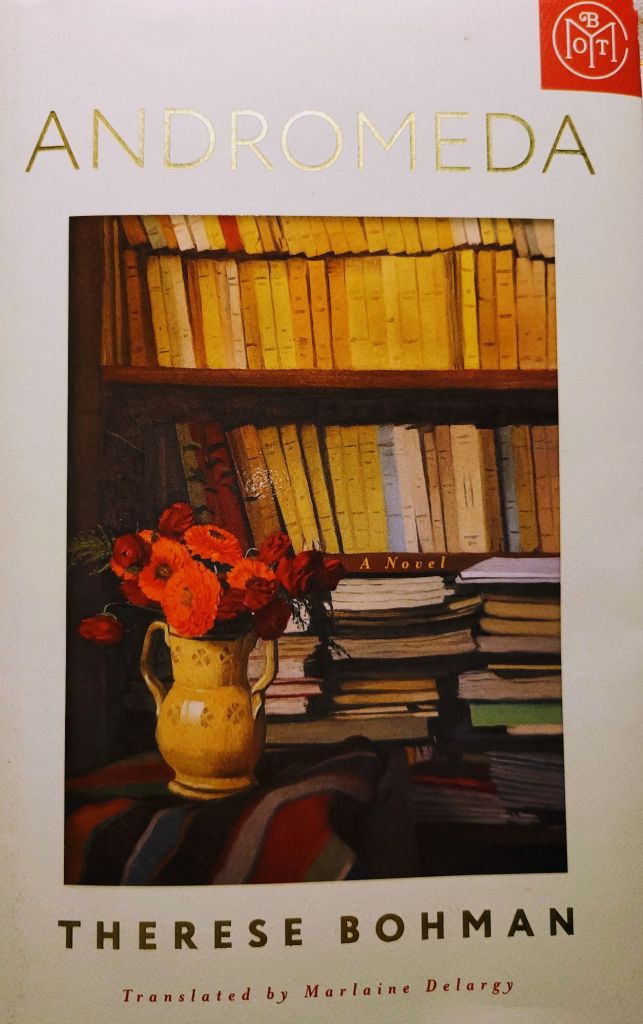
Review: Andromeda by Therese Bohman

I just finished a book that was so painfully relatable and so well-written that it took me two months to read.

I had to take it one page at a time, stopping and pondering on what it had said as if it were a book of poetry.

Each paragraph was written in flowing prose, usually on a mundane topic, but the final sentence for each paragraph was a sharp statement that carried weight and truth, even if it was only a couple of words.

This book held my heart and my senses. It read almost like a diary or as if you had found old letters that were too personal to read. Like you were peaking into the life of a person that was both relatable to yourself while simultaneously heartbreaking to relate to.

The themes discussed in the book were the old versus the new, tradition versus modernity, age versus maturity, art and literature versus life, and most of all the complicated emotions and relationships we find ourselves in.

The book is ANDROMEDA by Therese Bohman.

This book is NOT for everyone.

It tells the story from the perspective of two characters. One is a young woman who interns at a publishing house, and the other is an older man who is the editor of the publishing house.

I know what you are thinking, but hold on….

This isn’t one of those power dynamic relationships that leads to trouble. This isn’t about the ways in which men are controlling or women are victims. In fact, this technically can’t be considered a romance at all. Nothing happens.

This book is about relationships, yes. But it is more about how we want to be seen, how we see others, and how the little things in life all add up to equal our experiences. How life happens in the in-between spaces.

As someone who has had similar situations to the one in the book, I found it beautiful and heartbreaking. The topic was personal, but more than that, the execution was flawless.

It was aesthetic and poetic, and perfect. I almost cried when it was over. It was simultaneously about everything and nothing, and I highly recommend you read it if it sounds at all interesting to you.

The Life Experiences That Inspired My Writing

My stories are about healing.

Specifically, I am interested in how love can heal our deepest wounds and transform our lives. However, for my characters to need healing, they had to experience some form of trauma. And if you have read my work, you know that the trauma that my characters face is real and raw.

I’ll never forget reading a comment for Maple Creek from a reader who had left an abusive husband. She said, “We spent three months in a women’s shelter. I knew when I started reading this book, what it was about. Very good writing.”

Now if I’m being honest, overall, Maple Creek was in many ways a mistake and a stain on my career. I was inexperienced in publishing and I was in a very dark place in my life mentally and emotionally. I didn’t have an editor, and the moment I finished the book my cursor hovered over the button to delete the manuscript permanently.

In a moment of panic I published the book typos and all to save it from being wiped out of existence… by me. I told myself that if even one person liked it, I would continue my writing career. But there was no way anyone would like it, right? And needless to say, the book created some pretty reviews. most of the initial emotional reactions to the book were anger and disgust. Part of me felt validated in my low self-esteem.

But then, something remarkable happened:

The book received good reviews, too.

And not just good reviews, but some reviews that the book had been an emotional journey for the readers, that they related to it, loved it, and were sharing it with their friends.

How could a disaster of a manuscript like that receive any positive reviews?

The answer is this: because the story, in many ways, was true.

Obviously the characters and setting were fiction, but the deeper truth behind what the characters were expereincing was real.

I had been in and out of dangerous and abusive relationships, just like Sarah. And just like Sarah, I had a complicated relationship with my parents and the places from my past. And the inspiration behind Sarah and Emily’s love sprouted from the recent realizations that I, too, wasn’t straight. I’m an asexual panromantic. I’d had feelings for men and women, including trans women. And my relationship with sex had been complicated by my orientation coupled with the abuse and social pressures that I faced being raised as a girl in a hyper-sexual culture. And yes, many of my friends are queer and trans, and they have faced the same discrimination that the characters in the book did.

All of my stories, from books like Caravan or Miner of Mine to short stories like “Hope” are based on the personal traumas and healing experiences from my own life.

That’s why I went back and had editors fix them instead of deleting them. That’s why I continued to write and went on to find deeper healing, which I now continue to reflect in my stories and share with readers.

Because life isn’t perfect.

When we make mistakes, we need to heal them, not throw ourselves away. Because we need to know that we aren’t alone in the world. And most of all, because I want my stories to remind my readers that there is love in the world, and no matter what trauma we face, we can heal.